9/26/11

Swimming with Humboldt Squid: Photos and Pictures by Jon Schwartz

Swimming with giant schools of Humboldt Squid at night is creepy!
Saturday I drove to Newport to try free diving with the Humboldt Squid that have invaded Southern California. These strange sea creatures have been washing up on nearby beaches, and untold thousands continue to lurk in boiling masses just offshore.
Unlike the cigar-sized market squid that I encountered in June at La Jolla (click here to read that cool story), Humboldt Squid can be dangerous and I wondered if it was a good idea to get in the water with them at night. I've seen videos of them attacking divers, and in fact have spent a lot of time over the past decade seeking out every last bit of information about people that dive with Humboldts. The encounters are fascinating.
After calling several experts, I decided to give it a go. It turns out that this particular population of Humboldts was just the right size for me to investigate without having to worry about getting dragged down, body slammed, or chewed on. Actually they might chew on me a little bit.

The ones off Newport are about 2-3 feet long, and the biggest Humboldts can get 6 feet long and over 100 pounds. This might seem huge, but Humboldts as a species aren't even close to being the biggest squid in the ocean. Colossal Squid can get as big as a school bus, but they spend their time in the depths fighting off sperm whales in epic battles (or are those Giant Squid?) Here are two images I took off of Wikipedia. One shows a depiction of a sperm whale fighting a massive squid, and the other illustrates the relative sizes of Colossal and Giant Squids.
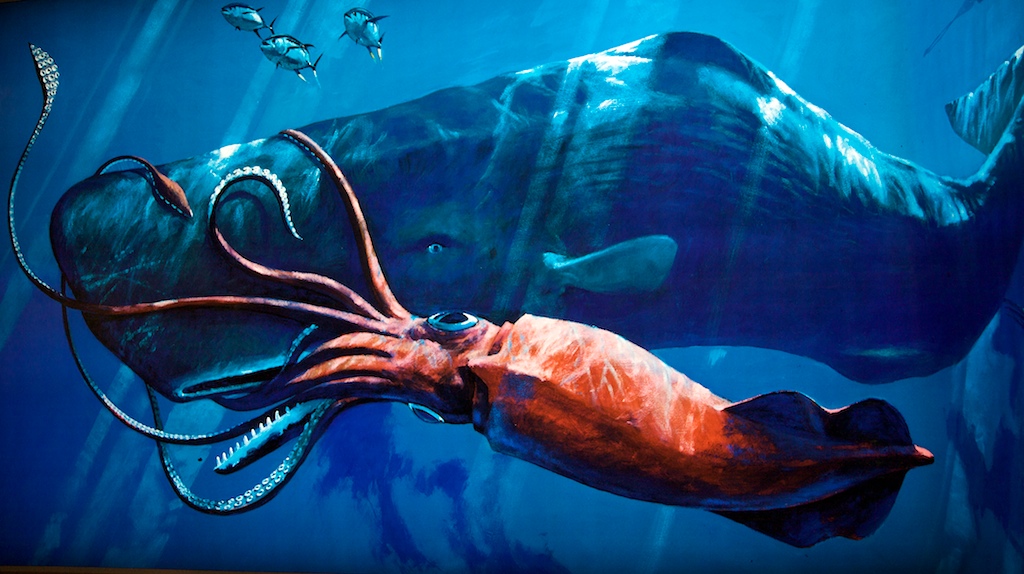
Sperm whales have been found on beaches covered with scars from the tentacles of massive squid, and their stomachs have been found to contain thousands of squid beaks.  Here's an old classic photo of a whale marred by squid tentacles.
Compared to these leviathans, the market squid I came across in La Jolla in June seem tiny. Here's one in my hand, and then a shot of them balled up in a school:
In any case, back to my more recent squid adventure. I guessed that unless the Humboldts in Newport ganged up on me, I'd be OK near the surface if I stayed close to the boat. These squid do have beaks that can take nasty bites, and their tentacles have sharp pointy things that rotate on them, but dogs can bite too, and I don't see people staying indoors on the off chance that they're going to get attacked by Fido. Maybe that's not the best analogy, but maybe you see my point. Compare the amount of people getting mauled by squids to the number mauled by dogs, and the result isn't even close.
Just after nightfall, we headed out. The bioluminescence from the red tide glowed a striking blue beneath our boat.
Finding the squid boats was easy; there was a flotilla lit up like a football stadium just outside of Newport Harbor, including open party boats stuffed to capacity with eager anglers, private yachts, and commercial squid boats that net them by the ton.
Here's some photos of a party boat:


Notice the anglers are wearing rain gear. This is to protect them against the squid that shoot geysers of ink and saltwater into the air. You can see them getting blasted!

I had hoped to find them schooling at the surface, but most of them lay at depths below 20 feet, which is just out of the range of my camera housing. I was able to see some in plain sight, and others remained invisible until they began blinking on and off like a strobe light. They can turn colors quickly, and I imagine they communicate with light. I jumped into the water, which was illuminated by the squid lights that the boats set below their boats.

This is what that water looks from below the surface:
As I was taking a picture of one that was hooked up to a fishing line, I was approached by a free swimming squid. This was what I had come for! My underwater equipment isn't really made for night photography so most of the time when I pressed the shutter, my strobe blinked spasmodically but my camera didn't take any pictures. I did get a precious few shots of this squid.  I'm not a squid expert but it seems to be an aggressive stance; check out how the tentacles are thrust forward at me. Was it waiting to strike, or was it merely checking me out? Someone who has dove with them referred to this as "attack mode" but again, I'm not a squidologist. I'd love to hear from some real experts as to what this stance means. If there are any out there please email me or add a comment to this blog.

I'll post more when I get a chance. I'm looking forward to a hands-on science lesson I plan to conduct with my first grade students. We'll use the one squid that I brought back from the adventure. I enjoy using fishing and marine science to engage my students in class and you can see an example of that here.
Below is a sample of our class work from today (9/29). It combines our work with temperature, reading, writing, science, and art. Fun stuff!
One of the neatest things about this Humboldt Squid encounter is that it marks the second time that I've been able to luck get neat photographs in an area close to my San Diego home. When I am not teaching school I often travel to locations like Hawaii, Mexico, and Panama for travel articles and big fish photos of game fish like marlin, sailfish, and tuna. 
Here are some photos from my recent trips: Kona Captain Teddy Hoogs, the Puerto Paraiso Mall in Cabo, and a striped marlin up close in the East Cape of Baja Mexico.
To see my travel, scenic, and fishing photo galleries, click here
To read my fishing and travel articles, click here
I used to catch and release marlin from kayaks and you can check that out here.

Photography Enthusiasts Take Note:
If you "Like" my Facebook Page Jon Schwartz Fishing, Photography, and Travel you might win a rare fine art print from my collection.

On October 10 I will randomly pick from 3 people who "Like" my Facebook page, and the winners will receive a FREE 16x20" gallery quality fine art print from my private stock! I sell these for 500.00 to private collectors so this is a neat opportunity.
Click here to see details.
Thanks!~
Jon Schwartz

8/16/11

Roosterfish! Exotic Fishing Photos from Baja Mexico's Sea of Cortez

The first time I saw a photo of a roosterfish, I couldn't believe my eyes. They looked like the world's weirdest fish!
About ten years ago I found out about them on the internet. I was thrilled with the fact that they get huge (the world record is over 100 pounds) and are caught in ultra shallow water. I became obsessed with catching one. Eventually I got into kayak fishing in the East Cape of Baja and learned how to catch them by trolling live bait like mullet or sardines behind my kayak. Here is a photo of the biggest one I ever caught, almost ten years ago. It was about 50 pounds.
 It was a tricky proposition because I had to keep the live bait in a bucket that I'd drag behind my kayak, and every time I'd let out a bait, I had to worry that the ravenous bandito needlefish were going to eat it. I kept two sardines pinned on hooks, and let them swim just off the side of my kayak so the pesky needlefish wouldn't venture too close and eat them. When I saw a rooster pass by me, I'd let a bait out.
Here's a photo I took of a smaller rooster that I released after catching it mere yards from the shoreline.

This was tons of fun but very hard work, and the equipment that I was using was rather primitive compared to fishing from boats. I even wedged the rods beneath my legs in lieu of rod holders.
Half of the battle was keeping covered up, surviving the blistering heat and sun, and keeping my bait alive.  In August the Sea of Cortez is so warm that I got little relief splashing ocean water over my head, so I had to take a cooler of ice and stuff it in the back of the yak.After much effort and patience I caught and released some big roosterfish (pez gallo in Spanish) and wrote many stories about my time on the water chasing these wonderful fish. Click here if you want to read one of them: Kayakfishing for Roosterfish Story

Years later I put down the rods and switched from kayak angling to big fish fishing photography for magazines, travel bureaus, and calendars. In fact, my new 2012 Offshore Angler Fishing Calendar published by Willow Creek Press is now available online and in stores, and here is what it looks like:
In any case, when I took up fishing photography, my interest in roosterfish returned. Once again I became preoccupied with these elusive, wild looking sea creatures. This time, however, I didn't want to just catch and release them from kayaks, I wanted to capture them on camera. A return trip to Baja was needed!

I hadn't been to the East Cape of Baja in many years and it was great to see all of my old friends. Luckily for me the roosters were around and biting, and I was able to get a lot of photos. Fishing photography requires a lot of luck, and I have taken many trips that have resulted in nothing. This time I hot the jackpot! Here's a big roosterfish looking at me like he's ready to pounce. This is probably the last image that many baitfish saw before they were eaten!
Below is a shot that shows how close they get to the beach. People even catch them from shore. That's one thing I have yet to do. Imagine hooking a 70 pound gamefish from shore! In fact a fellow named Gary Barnes-Webb, one of the world's most experienced roosterfish anglers, was spooled by a monster roosterfish while angling from shore while I was there. That means the fish emptied all of the line from his reel and kept on going! This one below has his trademark dorsal fins swept back.
Below is a roosterfish picture you're not likely to see often: two roosterfish in one image! Keep in mind each one was over 40 pounds. 
Some photos in this blog have blue water while others have green water because the fish were caught in different depths and locations. In my experience, blue water is usually clearer and better for fishing. If you show up for a fishing trip and they tell you the water is green, that's not good news. Then again this may not be true in all areas, just in the following areas I have fished: California, Mexico, Hawaii, Nicaragua, Panama, Costa Rica, and Guatemala.  If green water means good fishing where you live, contact me, as I'd be interested in hearing about it.

What do roosterfish eat? Well, as you can see in the above photo, I got to swim in the middle of a school of baby caballitos and I'm sure a roosterfish would have dined heartily on these tender morsels. This bait ball was feeding ravenously on small red pieces of spongy material that was so brightly colored I thought it was going to sting me. Look at how the bait is making the water boil at the surface. Pretty cool, huh? I was so stoked to be in the middle of all of this that I forgot to take my lens cap off and took about 150 shots with it on. Thanks Gosh I realized my mistake!
In addition to roosters, I got photos of some other interesting fish. Here is a underwater photo of a bull Dorado that ate a "hoochie" lure:
There were also plenty of Pompano. These fish are medium sized and fight dutifully for about 5 minutes. They'd be perfect for kids to catch because unlike roosters, they don't take a lot of muscle and strength to beat.
In addition to Roosterfish, Dorado, and Pompano, I also caught a striped marlin. I found that in some ways, they are harder to catch on a boat than a kayak. Pretty strange, huh? Years ago I hooked, fought, and released a bunch of striped marlin from kayaks on National Geographic TV's "Hooked: Monster Fish II" (click here to see Jon Schwartz on Nat Geo), and now that I have caught one from a boat, I can compare the two experiences.

Although each one of the marlin I caught from kayaks gave me a good workout, I don't remember feeling as exhausted and drained as I was after I caught this one from a boat! I'm embarrassed to say it took me over an hour. I wasn't using very heavy gear and the fish and I were locked in a stalemate. By the time it surfaced I was spent but I wanted some pics so into the water I went with my camera.
Interestingly, when I dove in with the marlin, I noticed that it has a tag in it. It had already been caught, tagged, and released by another angler. Below is a picture that shows the tag that was placed in him by another angler at an earlier time. Who knows when that was? Months? Years?
After we removed the hook, we sent the striped marlin back off to the briny depths from whence it came, a fitting end to another spectacular Baja adventure.

6/27/11

Giant Swarm of Squid Surrounds Fishing Photographer Jon Schwartz

Today I came face to face with a giant shoal of squid and got some amazing underwater pictures! I had hoped to get fishing photos of white seabass, thresher sharks, and yellowtail, but I never dreamed I would encounter a massive, frothing mass of squid. I really lucked out! This was a local Southern California excursion where I accompanied my kayak fishing friend Josh Pruitt. He has an uncanny knack for catching big fish from kayaks. When I'm not teaching school I enjoy taking big fish photos of marlin, sailfish, tuna, and sharks in tropical locations (which you can see on my site http://www.bluewaterjon.com/ and also at the bottom of this post).
Ironically, I don’t have many images depicting fish that inhabit the waters within walking distance of my house. Josh would be my guide to getting more San Diego fishing photos. He actually runs a kayak fishing guide service called Inshorekayak.com so having me tag along as a photographer was a snap for him.

We met at 3:00, launched our kayaks under cover of darkness, and paddled out to a spot over a mile offshore. Pruitt was able to locate shoals (or schools) of squid on his kayak’s fish finder and jig them up with a special lure. Josh kept 20 or so of these live squid in his bait well on the back of his kayak, and pinned one on his rod. Every so often he’d meter a fish (probably a white seabass) and drop a bait down, but he never got bit, and grey light passed without us hooking up.

We did see one boat that landed a big 30 pound yellowtail at 4:30 am, and I wanted to take pictures in the night time with my special low light camera. I refrained because I was too scared to take it out, make noise, and scare away the white seabass that might be lurking just below our kayaks. These “grey ghosts” are easily spooked and one tiny noise can scare them away for good. At 7:30am, Josh's rod bent over his kayak, and it was obviously a big fish. The plan was that if he hooked up, I’d tether my kayak to his, jump off my kayak with my underwater camera, and take photos of the fish as it swam below him.
I used to do a lot of kayak fishing, but over the last several years my passion for fishing photography and travel had taken over, and I had put down the rods and paddles and replaced them with cameras. Years ago I had every kayak gadget I needed, including a variety of leashes that I used to secure my rods and equipment in case I capsized. Below is a photo of a giant trevally, or ulua as they call it in Hawaii, that I caught on the Kona Coast while kayak fishing with my friend Steven Heusser. To read the great story behind this catch that involves tiger sharks and kayak fishing, click here,

At any rate, as I hadn't logged much time kayaking in the past couple of years, I couldn’t locate half of these leashes in my garage, and I did the best I could with what I could find. Honestly I was so focused on my camera gear that I wasn't thinking about the two rods that I brought along.

Murphy’s Law caught up with me when I slid off my kayak into the water with my camera. As soon as I got off, my kayak flipped upside down! I was holding on to a $4000 dollar underwater camera setup and through my mask, I could see some of my unleashed fishing equipment fall in slow motion from my capsized kayak, down into the murky depths. Josh said, "Grab your rod!” but I was more concerned with the other non-waterproof camera that was on (or under!) my kayak, and I made a half-hearted attempt to swim down and grab the sinking rod. I wish I had a video of all the shenanigans because it was all pretty hilarious; I must have looked like a total kook!

In any case, we righted my kayak and Josh resumed fighting his big fish. When it came close to the surface I got a lot of great underwater photos of the  fish, a big white seabass that must have weighed at least 40 pounds. After I took all the photos I needed, I climbed back in my kayak and started shivering uncontrollably. Brrr!! I had forgotten how cold it can get on the water in the summer. When the sun came up, I was grateful for some warmth.
Josh is an interesting kayak angler because he is able to stand up on his kayak and sight fish for big fish in the middle of the ocean. Many anglers do this on kayaks in ponds and lakes for small fish, but we were on the open ocean, and Josh frequently hooks huge fish while standing up! As we continued to paddle around (or I should say peddle), Josh noticed many schools of yellowtail feeding on the surface, but he wasn’t able to hook up.  Here is a video of us crusing around the open ocean. Notice how Pruitt is standing up, looking for any signs of life. He has a great eye like all top fishermen. I have had the pleasure of riding along with some of the world's top sportfishing captains like Marlin Parker, Gene Vanderhoek, Teddy Hoogs, and Guy Terwilliger (read about them here), and in my opinion Josh has the same qualities they do: an attention to detail, learning how the fish think and act, professionalism, and dedication. The main difference I can see is that his workstation isn't a 50 foot yacht, it's a 15 foot plastic kayak!

At about noon, Pruitt stood up for a bit and saw a red swirling mass of life close to the surface. All seasoned kayakers have seen schools of sardines, mackerel, smelt, and a number of other types of bait on the surface, but this wasn’t finned fish, it was squid…LOTS of squid!!!!

The first thing that came to mind for me was, can I ditch my kayak, get back in the water, and take pictures of them? Would they still be there when I got in? I had stashed my underwater camera in the hatch of my kayak and I would need to get that out, take off my booties, don my fins and snorkel, rub some defog on my snorkel lens, prep my camera, and most importantly, NOT capsize this time if I got in the water.

While I was trying to figure out if this was a good idea, Josh kept an eye on the huge mass of squid. Fortunately, it was hanging right next to his kayak. When I finally got in, I realized why: big fish were below the shoal, forcing them to flee to the surface, and at the same time, mackerel were attacking from the side, and birds were dive bombing them from above!
These squid were under siege and were using any protection they could get, and Josh’s kayak was the best they could find. Again I wondered, would they continue to stay when I swam close enough to take their picture? I swam down to take a shot from underneath, and my heart began racing because I knew that there was the potential for some rare underwater squid pictures.
Incredibly, when I surfaced for air and swam towards them, they swam right to me!! They looked otherworldly, and I could see and feel hundreds of eyes trained on me. I felt as if I was being approached by a group of intelligent beings rather than fish; something about the way they moved and pulsed rhythmically made me feel connected to them.
 I kept closing the distance and soon I was in literally in the middle of the shoal, completely surrounded by thousands of squid. My camera was on full burst mode, clicking at 8 frames per second. I hoped and prayed that my camera settings were correct, because if what I saw with my own eyes was being captured on film, I’d have some incredible photos!! The huge mass of squid kept going past me towards the kelp forest, but several stragglers stayed with me and hovered inches from my mask.
They were using me as a source of protection! Was this a good thing? Had I been in Hawaii, where I do a lot of underwater photography with marlin, sailfish, and tuna, I would have been terrified, because being surrounded by prey would have made me a target, but I figured that with there being no huge predators feeding on the squid (other than sea lions and maybe the occasional smaller shark), I felt relatively safe.

The squid were so close that I thought, “I could probably just reach out and grab one!” and so I did.

The one squid I grabbed didn’t seem to mind and I wasn’t holding it too tightly; I cradled it like a pet mouse. My next thought was, “No one is going to believe this!” so I turned the camera around, gently placed the live squid in my mouth, and took a self portrait.
The squid seemed pretty calm. Could it sense I meant it no harm? When I took it out of my mouth it was still uninjured. I then released it and surfaced to tell Josh about all that I had experienced. I was beside myself with excitement and gasping for air!

Knowing that I might have just captured some of my best underwater photographs to date, I gently placed my underwater gear back in the hatch, and by 3:00pm, twelve hours after we had peddled out into the surf in the pitch black night, we were landing our kayaks amidst hundreds of beach going tourists enjoying a hot summer day. When I got home an hour later and viewed the photos of the squid on my laptop, my jaw dropped in disbelief; the pictures came out even better than I had hoped!!

Days later my squid photos appeared on the front page of the San Diego Union Tribune and I was featured on San Diego's CBS TV station KFMB. Here's a clip pf the video below:


P.S.- Here are some of my recent travel and fishing photographs. I also have just taken up surf photography as you can see here with my shot of these tandem surfers in at the Queens surf break in Oahu's Waikiki:
Here's a shot of the Puerto Paraiso Mall in Cabo. Pretty swanky!
Dorado, mahi-mahi, or dolphin: what do you call these golden jewels?
Face to Face with a blue marlin: Hawaii's Kona Coast.
Here's a rare shot of a blue marlin, shot while I was in a helicopter!
About the Author:
Jon Schwartz (http://www.bluewaterjon.com/) contributes to fishing and travel magazines worldwide, and has been featured on Nat Geo TV for catch and release kayak fishing for marlin. Jon lives in San Diego his wife and 3 daughters, teaches elementary school, and enjoys teaching technology to his students and taking kids fishing. Check out his elementary student blogging site http://www.kidslikeblogs.org/  and this video of him Jamming with his students!